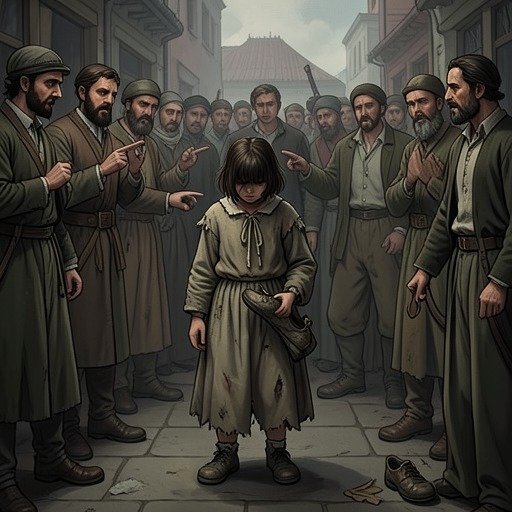
Esmeralda and her mother's matching embroidered shoes
The Hunchback of Notre DameEsmeralda and her mother's matching embroidered shoes are the small, tangible means by which Gudule recognizes her lost daughter. Separated since infancy, the shoes preserve a connection that memory, rumor, and accusation have obscured: when the pair is brought together, the charm attached to one directs a mother toward her child, and the child toward her mother.
Origin and Separation
The shoes enter the story through Mahiette's account of Paquette la Chantefleurie and her infant daughter, Agnes. When an itinerant group came to Reims, people flocked to have their fortunes told despite rumors that its members stole children and purses. Paquette, curious about her own future and her daughter's, took the child to them. The women admired Agnes, kissed and caressed her, and were especially taken with her feet and shoes. Their attention pleases Paquette: the predictions promise that her daughter will be beautiful, virtuous, and a queen.
Agnes is not yet a year old. Paquette returns home proud of the future imagined for her child, then briefly leaves the sleeping infant alone while telling a neighbor about the prophecies. When she comes back, the door stands wider open than she left it and the child is gone. The narrative places the disappearance amid the theft rumors surrounding the visitors, but the shoes become more enduring evidence than those rumors: one remains with the bereaved mother, while its mate travels with the child.
The pair's separation is also a division of keepsakes. Gudule holds the little embroidered shoe as the surviving possession of the daughter she believes was taken from her. Esmeralda wears a small bag ornamented with green glass around her neck; inside it, she keeps the other shoe. The matching objects have therefore remained close to both women through years in which neither knows the other's identity.
The Shoes as a Sign of Kinship
The shoes do more than resemble each other. A parchment attached to the shoe in Esmeralda's bag bears a charm promising that when its mate is found, the wearer's mother will open her arms to her. That message makes the object a sign with a specific condition: reunion depends on the two separate shoes being recognized together. Until then, each can be mistaken for an isolated keepsake; placed side by side, they disclose a relationship neither woman can establish from appearance or accusation alone.
The contrast between the charm's promise and the women's circumstances gives the shoes their force. Gudule has spent fifteen years grieving for her lost child, while Esmeralda has been searching for her parents. At their encounter, neither begins with certain knowledge of the other's identity. Gudule invokes the stolen child and shows Esmeralda the shoe she has kept; Esmeralda, trembling, asks to see it and opens the green-glass-ornamented bag at her neck. The second shoe, absolutely similar to the first, makes the private token legible to both of them.
Recognition Across the Bars
The recognition takes place through the window of Gudule's cell, with an iron barrier and wall still physically dividing mother and daughter. After Gudule lays the shoes together and reads the parchment, her cry of recognition is answered by Esmeralda's. The compact exchange reverses their earlier mistaken positions: the woman who had treated Esmeralda as the child-stealing enemy recognizes her as her own child, while the young woman who had said she was seeking her parents names Gudule as her mother.
The shoes do not themselves overcome the barrier. Instead, their proof intensifies the scene's separation: Gudule can identify and see her daughter but cannot embrace her through the bars. Esmeralda passes an arm through the opening, and Gudule kisses her hand, sobbing and weeping in silence. The preserved shoe, an object held through years of grief, is answered by the matching shoe brought unknowingly against it; the reunion becomes bodily only in this limited contact across the cell's opening.
The recognition also changes the force of Gudule's earlier accusations. At the window she had called Esmeralda a child-stealer and cursed her as the daughter of Egypt. The paired shoes replace that inherited suspicion with intimate evidence. Their meaning is not a general proof about the people Gudule feared, but a particular truth about these two women: Esmeralda is Agnes, the child Gudule lost.
Material Afterlife and Narrative Significance
The shoes' importance rests on their physical continuity. One is a keepsake Gudule has preserved; the other has remained in Esmeralda's little bag, close to her body. They survive the years of separation without either woman knowing that the other possesses its match. The reunion depends not on an abstract recollection but on the comparison of two material objects and the parchment carried with one of them.
The closing account of the remains at Montfaucon recalls the green-glass-ornamented silk bag around the woman's neck, open and empty. The passage does not say that the shoes themselves were found there, so the bag's presence should not be mistaken for a further recovery of the pair. It does, however, return to the object that accompanied Esmeralda and participated in her recognition of Gudule. In the final account, the empty bag is a remnant associated with a woman whose remains are held in an embrace; the shoes' earlier promise of reunion stands in stark contrast to that ending.
As a plot device, the matching pair makes concealed kinship recognizable at the decisive moment. As a keepsake, each shoe has endured in the custody of one half of a separated family. Their smallness sharpens the contrast between the scale of what they establish and the violence and grief surrounding the discovery: two embroidered shoes, brought together at a barred window, restore a mother's name to the daughter she had lost.